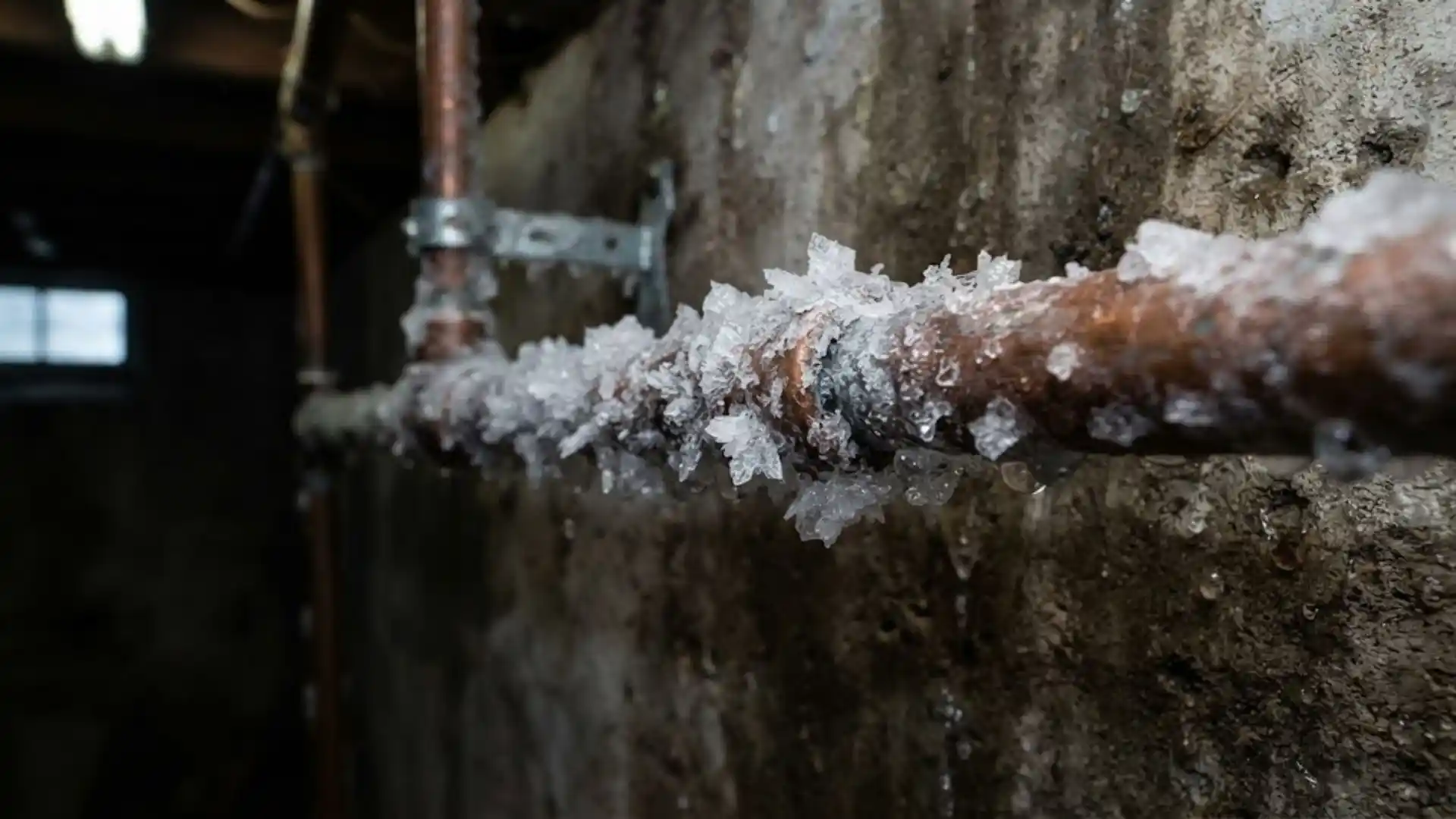
Every winter, Pleasant Grove's dispatch phones get busiest during the same weather pattern: a hard, multi-day cold snap driven by a valley inversion that traps freezing air in place. Homeowners often assume any freezing temperature puts pipes at risk, but the actual threshold is more specific than that, and knowing it can help you decide when precautions are just good practice versus genuinely urgent.
The Actual Threshold
Pipes generally don't freeze and crack the moment the temperature dips below 32°F. The more meaningful threshold is sustained exposure to roughly 20°F or colder for six hours or more, particularly for pipes that sit in an uninsulated space like a garage, crawlspace, or an exterior wall. Utah's winter inversions are exactly the kind of weather event that produces this, cold air gets trapped in the valley for days at a stretch, rather than the temperature dipping briefly overnight and recovering the next afternoon.
What actually breaks a pipe isn't the ice itself. As water freezes, it expands, and that expansion builds pressure inside a sealed section of pipe. The pressure keeps building until something gives, often not right at the ice itself, but at a weaker point elsewhere in the line. This is part of why a pipe can crack quietly while still frozen, with no visible sign of a problem, and the flooding only shows up during the thaw when the pressure behind the ice finally releases all at once.
Where This Happens Most In Pleasant Grove
Homes in Pleasant Grove's older neighborhoods (areas like Grove Creek, the Old Fort, and Sam White's Lane) see this more often than newer construction, since plumbing in these areas sometimes runs through unheated crawlspaces or along exterior walls without the insulation standards used in current builds. Vacation properties and homes between tenants are also a recurring source of calls, since a property with the heat set too low, or off entirely, has no buffer at all during a hard freeze.
What Actually Prevents It
A few specific, low-cost habits address most of the risk. Disconnect and drain outdoor hose bibs before the first hard freeze of the season, since these are one of the most commonly forgotten exposed lines. Insulate any exposed supply lines running through a garage or crawlspace, foam pipe sleeves are inexpensive and take an afternoon to install. During an active cold snap, keep cabinet doors open under sinks that sit against exterior walls, so warm room air can actually reach the pipe instead of being blocked behind cabinetry. And critically, never let a home's heat drop below about 55°F, even in a property that's vacant or between tenants, many insurance policies specifically look at whether reasonable heat was maintained when reviewing a burst pipe claim.
If A Pipe Has Already Burst
The first step is always the same: shut off the main water supply immediately, since a burst pipe can release hundreds of gallons before it's noticed, especially if it happens overnight or while no one is home. Once the water is off, burst pipe repair covers both the extraction and drying side of the response, which we coordinate directly with a licensed plumber handling the actual pipe repair. The faster extraction starts, the less likely the loss is to spread into drywall, flooring, and framing beyond the immediate area.
This pattern isn't unique to Pleasant Grove, homeowners in nearby American Fork face the same inversion-driven cold snaps and the same freeze risk in older, similarly-built homes.
Why Some Homes On The Same Street Have Different Risk
It's common for one home on a block to have a burst pipe during a cold snap while the house next door, built around the same time, doesn't. The difference usually comes down to specific plumbing routing decisions made during original construction or a later remodel, whether a supply line runs along an interior wall or an exterior one, whether a garage is heated or not, and how well insulated the specific wall cavity containing the pipe actually is. Two homes with nearly identical floor plans can have meaningfully different freeze risk based on details like this that aren't visible without knowing where the plumbing actually runs.
What We See After The Thaw Specifically
The timing of when a burst pipe is actually discovered follows a predictable pattern tied to the thaw, not the freeze itself. During a hard multi-day cold snap, a cracked pipe often produces no visible sign at all, since the ice plug in the line prevents water from actually flowing anywhere. It's only once temperatures climb back above freezing, sometimes a day or two after the coldest part of the cold snap has passed, that the ice fully melts and water starts moving through the crack. This is why our call volume for burst pipes tends to spike on the first mild day after a hard freeze rather than during the freeze itself, and why checking exposed plumbing proactively during the cold snap, rather than waiting to see if a problem shows up, is worth the extra effort.
A Quick Pre-Winter Checklist
Before the first hard freeze each year, walk your property and note every exposed hose bib, every pipe run through a garage or crawlspace, and every exterior wall with plumbing behind it. Insulate what you can, disconnect and drain hoses, and confirm your furnace is functioning well before you actually need it during a cold snap, since a furnace failure combined with a hard freeze compounds the risk considerably.
If your home will be empty for an extended stretch this winter, consider asking a neighbor to check on it periodically, or look into a smart water sensor system that can alert your phone the moment it detects moisture, giving you a chance to respond before a small leak becomes a major loss.
None of these precautions require special skills or significant expense. A few hours of prevention each fall is consistently cheaper and less disruptive than a single burst-pipe emergency during the coldest week of the year.
The Bottom Line
Freezing temperatures alone aren't the real risk in Utah, sustained cold, in the range of 20°F or below for six-plus hours, is what actually threatens exposed plumbing. A handful of preventive habits each winter, focused on insulation and maintaining minimum heat, prevents the vast majority of the burst pipe calls we take.