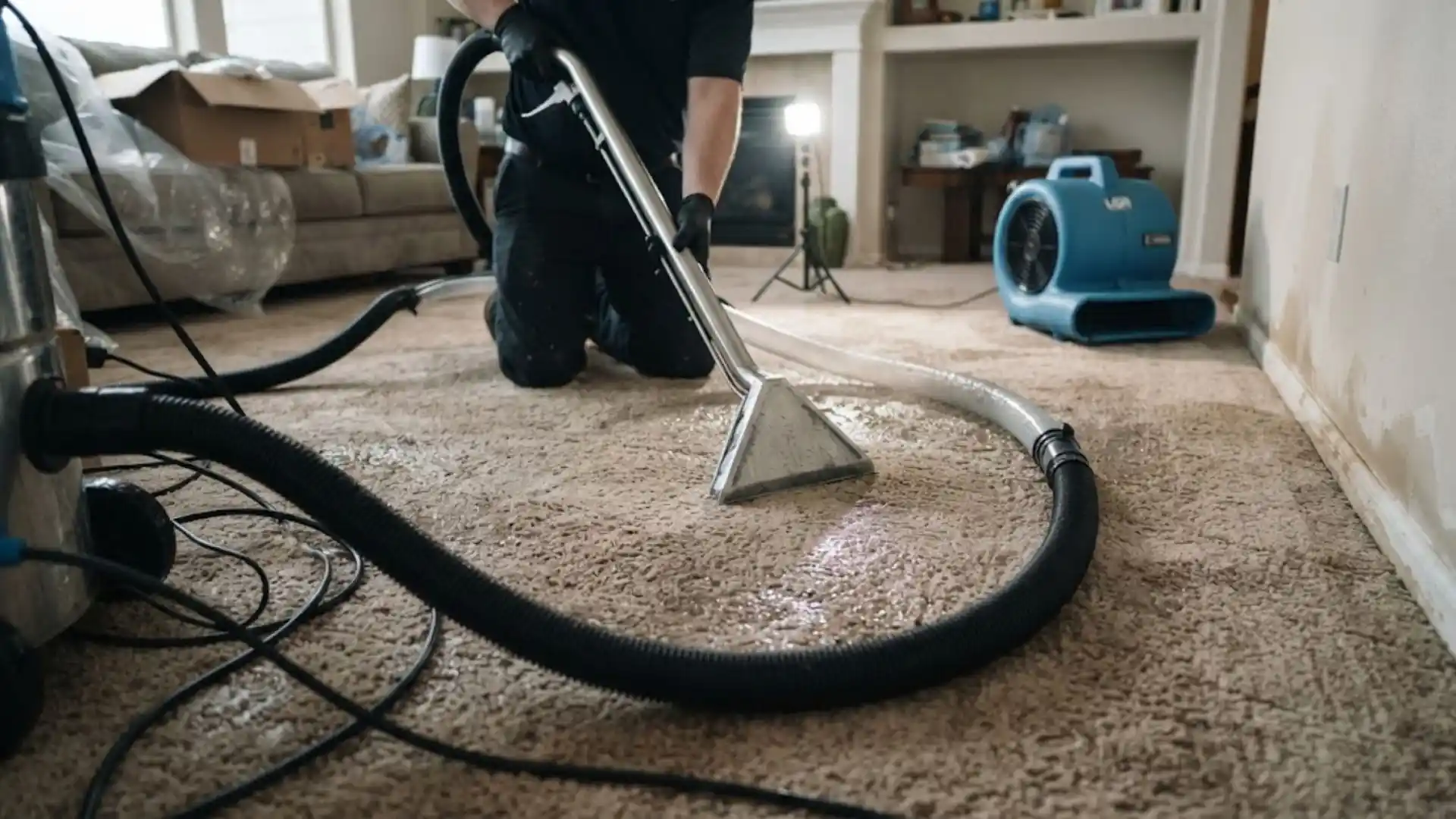
Water mitigation is the first, time-critical response to an active water loss, stopping the water, removing what's standing, and drying the structure before secondary damage like…
Water mitigation is the first, time-critical response to an active water loss, stopping the water, removing what's standing, and drying the structure before secondary damage like warped flooring, delaminated drywall, or mold sets in. It's distinct from full restoration, which handles the rebuild after mitigation is complete. In Pleasant Grove, most mitigation calls come from one of three sources: a spring snowmelt event overwhelming a sump pump, a summer storm, or a winter burst pipe.
The first 24 to 48 hours after a water loss determine how much of the structure and its contents can be saved versus replaced. Our mitigation process is built around that window: rapid extraction, moisture mapping to find water that's migrated into wall cavities or under flooring, and industrial drying equipment set to pull humidity down before materials have a chance to start breaking down.
Insurance carriers generally distinguish between mitigation costs, which they consider necessary to prevent further loss, and full restoration costs, which rebuild what was damaged. Starting mitigation immediately, even before a claim is fully approved, is usually in a homeowner's interest, since most policies expect reasonable steps to limit the loss and delaying extraction can be used to argue a claim should be reduced.
Equipment stays on-site for the full drying period rather than being dropped off and picked up on a fixed schedule, because drying time varies by how much material absorbed water and how humid the surrounding air is. We check moisture readings daily and adjust air mover and dehumidifier placement as materials dry unevenly, which is common in a room with both hard flooring and absorbent materials like drywall in the same space.
Sudden plumbing failures, often following a hard winter freeze.
Water heaters, washing machines, and dishwashers that leak or rupture.
Pumps overwhelmed by spring snowmelt or failing during a power outage.
Water entry from storm damage or aging seals.
A crew can begin assessment today.
Water source identification and shutoff guidance over the phone if needed.
Rapid removal of standing water using truck-mount or portable extraction equipment.
Moisture meters and thermal imaging to find water hidden in walls and subfloor.
Air movers and dehumidifiers set and monitored until materials reach a safe moisture level.
Ranges are typical starting points. A same-day, no-obligation assessment confirms exact scope and price in writing before work begins.
The severity table above reflects mitigation costs specifically, not any rebuild work that follows. A homeowner comparing our mitigation estimate to a competitor's should confirm whether that estimate also includes rebuild, since bundling the two into one number can make an apples-to-oranges comparison look cheaper than it actually is.
A typical mitigation call starts with a homeowner noticing water where it shouldn't be — pooling in a hallway, seeping from under a baseboard, or dripping from a ceiling — and not being sure yet how bad it actually is underneath the visible surface. Part of the first visit is simply establishing that scope: how far the water has traveled, which materials it's touched, and whether what looks like a contained puddle is actually sitting on top of a subfloor that's already saturated.
Waiting even a single day to start mitigation after a water loss can shift a job from a straightforward drying project into one that also requires material replacement, since the threshold at which drywall, insulation, and subfloor stop being salvageable moves faster than most homeowners expect.
Mitigation stops the loss and dries the structure; restoration is the rebuild afterward, like drywall, flooring, and paint.
Most residential jobs take 3 to 5 days of monitored drying, depending on how much material absorbed water and how long it sat before extraction started.
Yes, we relocate or block-and-tab furniture as needed to protect it and to access affected flooring.
Incomplete drying is one of the most common causes of mold appearing weeks after a water loss, which is why we monitor moisture levels daily rather than estimating drying time up front.
No, most policies expect immediate action to limit further damage; we document everything so the mitigation work supports rather than complicates your claim.
Call now for emergency dispatch anywhere in Pleasant Grove and Utah County.
☎ Call (385) 410-8926