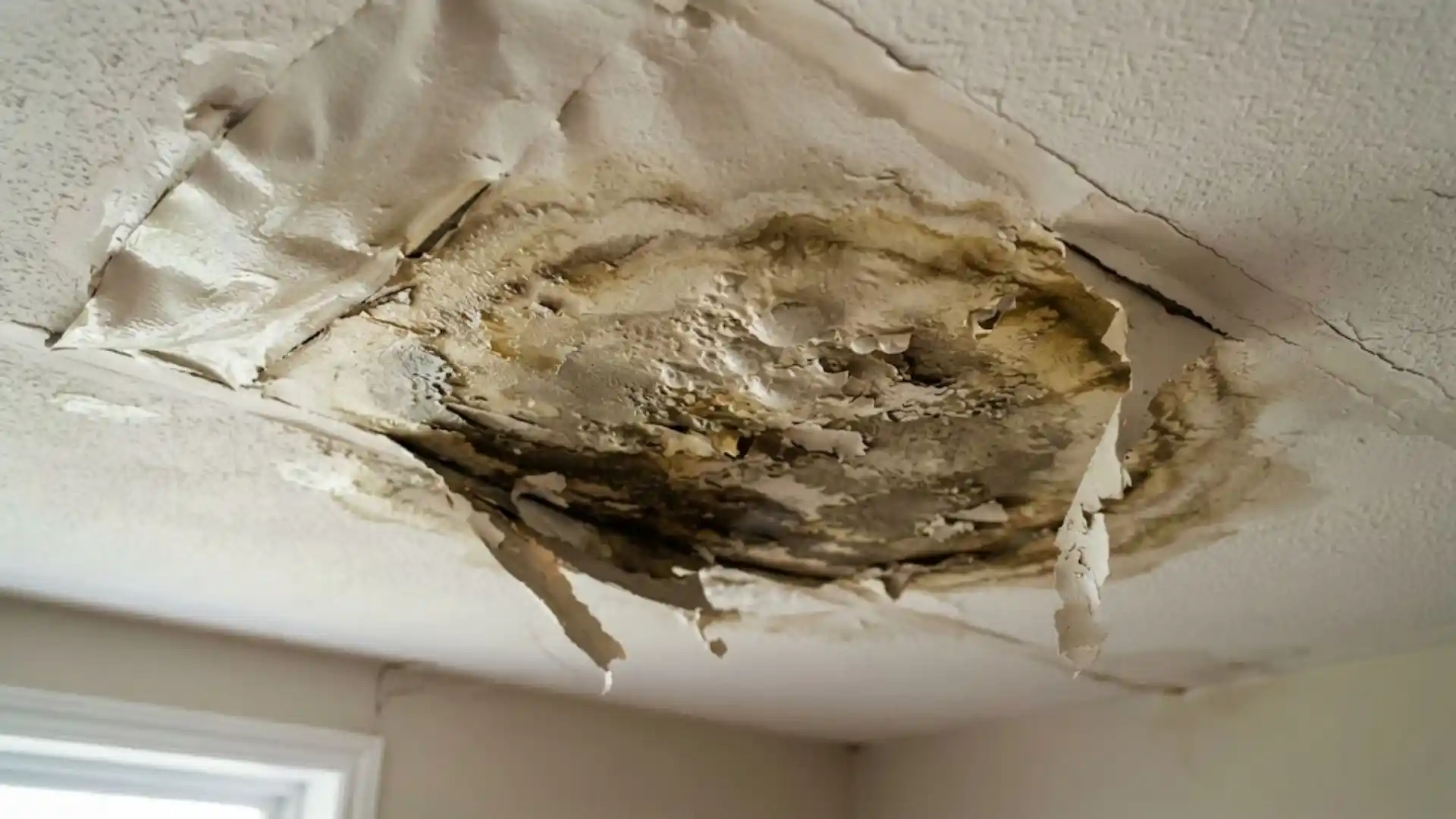
One of the most common calls our dispatch line takes isn't a flooded basement at all. It's a homeowner who's noticed a soft spot or discoloration forming on a ceiling below an…
One of the most common calls our dispatch line takes isn't a flooded basement at all. It's a homeowner who's noticed a soft spot or discoloration forming on a ceiling below an upstairs bathroom. An upstairs toilet or shower leak can drip into a ceiling cavity for days or weeks before it's visible, and by the time a stain or a soft, sagging spot appears, water has usually already saturated the drywall and insulation above it.
Ceiling water damage repair starts with finding the actual source, which is often not directly above the visible stain due to how water travels along joists before dripping down. Once the leak is stopped, we remove saturated drywall and insulation, dry the remaining structure, and rebuild the ceiling to match the original finish.
Insurance adjusters reviewing a ceiling water damage claim often want to see documentation of when the leak was discovered versus how long it may have been active, since a slow leak that went unnoticed for months is sometimes treated differently than a sudden pipe failure. We photograph the extent of saturation and note our assessment of how long the moisture appears to have been present as part of the documentation we provide.
Texture matching is often the trickiest part of a ceiling repair, since many Pleasant Grove homes built in different decades have different original ceiling textures, and an exact match sometimes requires blending techniques rather than a simple patch. We account for this in the written scope so there are no surprises about how the finished repair will look compared to the surrounding ceiling.
Toilet, shower, or tub leaks dripping into the ceiling below.
Water entering through damaged shingles or flashing, especially after a storm.
Attic ductwork or units leaking condensation into ceiling cavities.
Supply or drain lines running through a floor system that fail.
A crew can begin assessment today.
Tracing the water back to its actual origin point, not just the visible stain.
Removing any standing water in the ceiling cavity.
Cutting out saturated drywall and insulation that can't be dried.
Drywall, texture, and paint repair matched to the surrounding ceiling.
Ranges are typical starting points. A same-day, no-obligation assessment confirms exact scope and price in writing before work begins.
Ceiling repair costs vary significantly based on whether the ceiling has texture, and if so, what type. A smooth, flat ceiling is straightforward to patch and repaint; a heavily textured or hand-troweled ceiling from an older Pleasant Grove home often costs more to match well, since the technique itself takes more skill and time.
A typical ceiling call starts with something as small as a coffee-cup-sized brown spot that's been there for a week or two before anyone called, having assumed it was old and no longer active. Pressing on it gently often reveals it's actually still soft, meaning the leak above hasn't been fully resolved even though nothing is visibly dripping.
A soft ceiling spot that's left unaddressed doesn't stabilize on its own; continued exposure, even from a slow, ongoing leak, keeps weakening the same section of drywall, which is why a spot that was firm enough to walk near last month can become a genuine collapse risk without further obvious warning.
It usually means drywall has absorbed enough water to lose structural integrity, and it should be treated as urgent since a soft ceiling can collapse without warning.
Yes, water often runs along a joist or subfloor before dripping down, so the visible stain isn't always right below the source.
Yes, when a ceiling leak has been active long enough for mold to start in the insulation or drywall, we can quote both the water damage repair and mold remediation together.
Sudden plumbing failures are typically covered; slow leaks that went unnoticed for a long time are sometimes treated as a maintenance issue instead, depending on the policy.
A severely saturated ceiling can fail with little additional warning beyond the soft spot itself, which is why we recommend treating any sagging or soft ceiling area as urgent rather than waiting to see if it gets worse.
Call now for emergency dispatch anywhere in Pleasant Grove and Utah County.
☎ Call (385) 410-8926