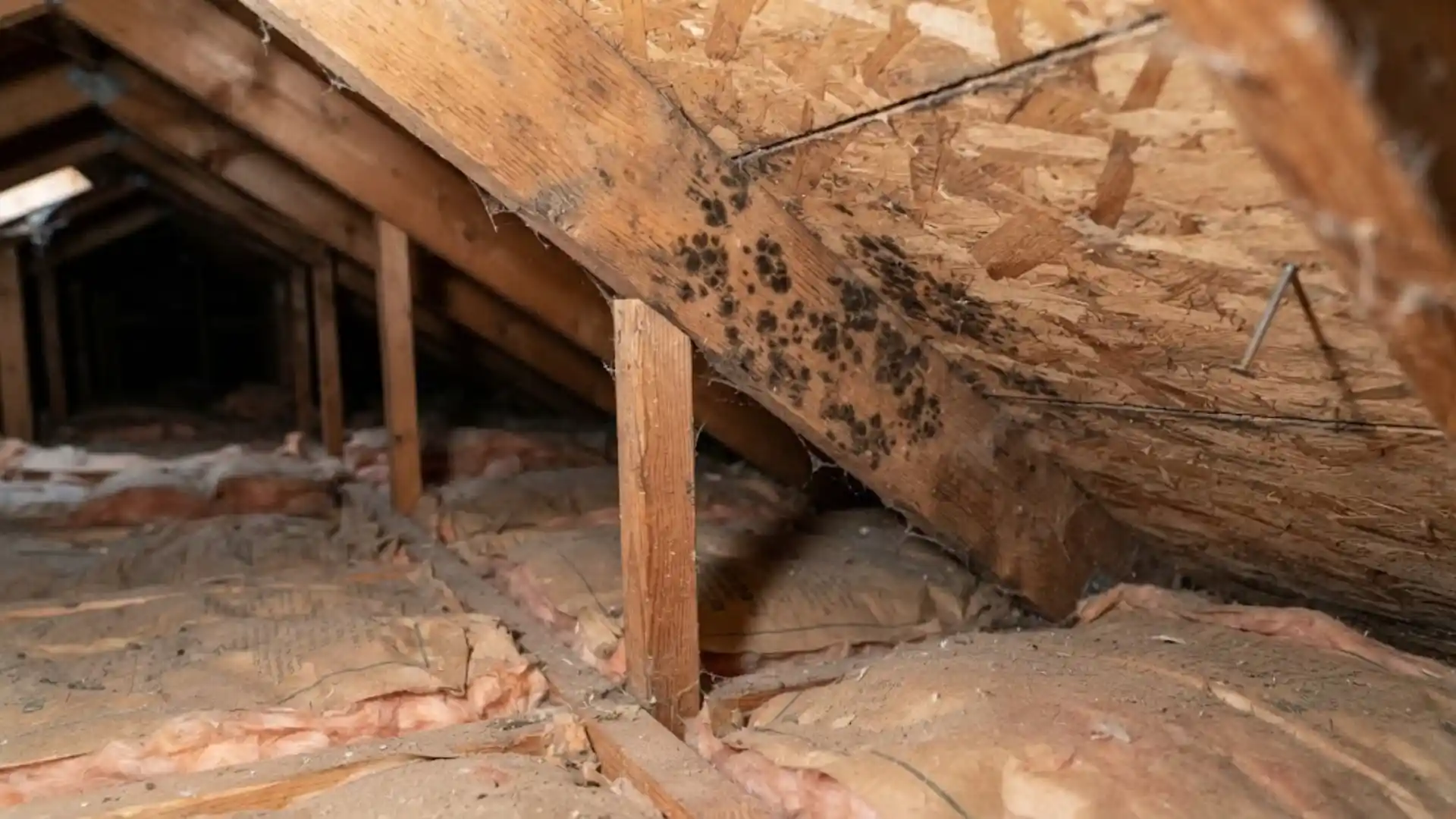
Attic mold in Pleasant Grove homes is almost always a condensation problem rather than a flood problem, warm, moist indoor air escaping into a cold attic space during winter, or…
Attic mold in Pleasant Grove homes is almost always a condensation problem rather than a flood problem, warm, moist indoor air escaping into a cold attic space during winter, or inadequate soffit and ridge ventilation trapping humidity year-round. Bathroom exhaust fans that vent into the attic instead of outside are one of the most common causes we find during inspection, quietly pumping moisture into the space every time a shower runs.
Because attic mold is usually a ventilation issue rather than a one-time event, removal alone often isn't a lasting fix. We address the mold itself and flag the underlying ventilation or insulation issue so the problem doesn't simply return within a season.
Because attic access is often limited to a single pull-down ladder or a small hatch, we take extra care with containment to keep spores from migrating into the living space below during removal, sealing the access point and using negative air pressure equipment sized appropriately for the confined space an attic typically presents.
After removal, we recommend a follow-up check the following winter to confirm the ventilation fix actually resolved the condensation pattern, since some attic ventilation issues take a full heating season to fully reveal whether the correction was sufficient.
We take before-and-after photos of the treated roof sheathing so you have documentation of the work completed, which can also be useful if you sell the home later.
We check insulation depth and condition while we're already in the attic, since inadequate insulation often contributes to the same condensation pattern that caused the mold in the first place.
If your attic has multiple sections separated by framing, we check each one individually rather than assuming a single ventilation issue explains mold found throughout the whole space.
Inadequate soffit or ridge venting trapping humid air.
Exhaust fans that terminate in the attic instead of outside.
Winter ice dams forcing meltwater into the attic space.
Gaps allowing warm, moist indoor air to condense on cold roof sheathing.
A crew can begin assessment today.
Assessing ventilation, insulation, and moisture sources.
Sealing the attic access point to prevent spore spread into living space.
HEPA vacuuming and treatment of affected roof sheathing and framing.
Flagging any soffit, ridge vent, or exhaust fan issues contributing to the problem.
Ranges are typical starting points. A same-day, no-obligation assessment confirms exact scope and price in writing before work begins.
Removal costs increase notably when insulation has to be replaced in addition to cleaning the roof sheathing itself, since wet or contaminated insulation generally can't be salvaged and reinsulating an attic adds both material and labor cost to the base removal price.
A typical attic mold discovery happens during an unrelated task — a homeowner going up to store holiday decorations and noticing dark staining across the roof sheathing that wasn't there the last time they were up there, often more widespread than a single glance from the attic hatch suggested.
Attic mold left unaddressed for multiple seasons can begin affecting the structural integrity of roof sheathing, not just its appearance, which turns what might have been a surface-level removal into a job that also involves structural material replacement.
Attic mold is usually caused by condensation from trapped humidity, not flooding, often from poor ventilation or a bathroom fan venting into the attic instead of outside.
It can affect indoor air quality over time, especially if spores migrate into living space through attic access points or HVAC returns.
Usually not, unless the sheathing has structural rot; most cases are resolved with mold removal and a ventilation fix.
An inspection can confirm this quickly; a fan venting into the attic is a common and fixable cause of recurring mold.
Not if containment is done properly, we seal the attic access point and use negative air pressure specifically to prevent spores from migrating into the living space during removal.
Call now for emergency dispatch anywhere in Pleasant Grove and Utah County.
☎ Call (385) 410-8926